
Revolutionize Learning and Development with your own white-label AI coach platform to engage employees or clients in their personal development and learning journey.

Personalized Learning Journeys:
Tailor coaching experiences to individual needs and goals. Rocky.ai's AI engine personalizes interactions, identifies strengths and weaknesses, and suggests relevant content for continuous improvement.
Engaging Microlearning:
Break down complex topics into bite-sized, interactive modules that are easily digestible and readily available on-demand. Promote knowledge retention and improve completion rates.
Conversational Coaching:
Create a dynamic learning environment where users can have daily chats with their AI coach. The AI provides guidance, answers questions, offers encouragement, and keeps users motivated throughout their learning journey.
Effortless App Creation:
No coding required! Build your own white-labeled coaching app with a user-friendly interface. Rocky.ai provides the AI foundation, allowing you to focus on crafting exceptional content.
Data-Driven Insights:
Gain valuable insights into user progress and engagement. Rocky.ai's analytics dashboard allows you to track progress, identify areas for improvement, and tailor your coaching programs for maximum impact.
Scalability and Cost-Effectiveness:
Extend your reach and empower a larger audience without breaking the bank. Rocky.ai for Businesses offers a scalable solution that's cost-effective, allowing you to deliver personalized coaching at a fraction of the cost of traditional methods.


Promote a culture of continuous learning with an engaging and interactive platform, leading to higher engagement and better outcomes.

Rocky is the perfect complement to your coaching and will serve as the best follow-up tool. Integrate you brand into the app and create your exclusive training product.

Its customized intelligent journaling process creates a bespoke user experience for the self-development journey of thousands of users.
Create your White Label AI Coach and Digital Twin


Visit our user-friendly platform, Rocky for Teams.
Access a simple dashboard, from which you can monitor the engagement, performance and progress of your team and coachee.

Invite your coachee to download the free app to optimize their potential. Allocate individuals into specific groups for desired learning outcomes. Effortlessly tailor the programs to meet individual needs.

Interact with your clients in real time, to maximize accountability towards goals. Control this easily from the comfort of your ROCKY for COACHES dashboard, which communicates straight to their app and keeps momentum high.
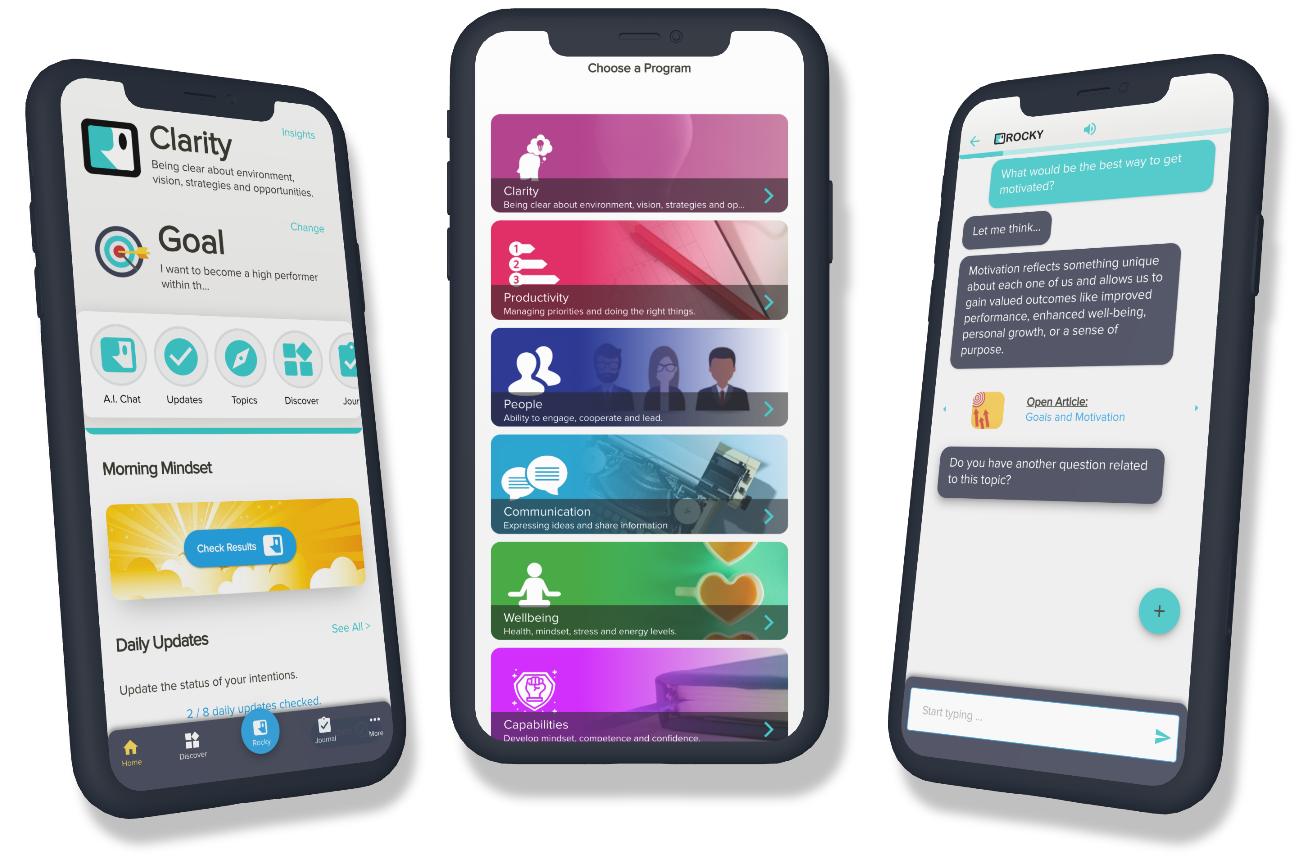
Create a bespoke growth plan for every team member.
Monitor each person’s daily progress, as they work through the assigned developmental topics automated and AI-powered.
A single dashboard gives you an instant overview of each team member’s progress. Keep track of their engagement and personal reflections, so that you can intervene and support at the right time. You can dial up or down your own engagement in response to that of your group.


From a single dashboard to optimise time and cut out the noise from other channels, you can set up groups and teams, monitor engagement, and intervene where necessary through direct messaging to offer help, support and encouragement.

Make accountability fun and easy for your team members, by sending reminders straight to them to their Rocky Mobile App through your access on Rocky Web App.

With a wealth of content based on the research of optimal human functioning, let Rocky inspire
each team member through its bite-sized tailored tips and catalyse each coachee to peak performance.

Rocky will keep morale high, through its customised use of AI to select the right quotes, articles and recommendations. Rocky cultivates the Growth Mindset and development becomes fun.
Yes. Full white-label deployment with your branding, custom voice, avatars, domain and a backend dashboard tracking skill progression across the workforce.
For consultancies, training providers and large HR functions, the branding is a commercial asset rather than decoration.
A training provider can deliver AI roleplay as their product, with their scenarios, their assessment rubric and their brand — rather than reselling a platform their client could buy directly. That's the difference between a reseller margin and a product business.
For an internal L&D function, it's the difference between "HR bought a simulation tool" and "this is how we build capability here." Employees respond to the second framing considerably better, and adoption reflects it.
Included: your logo and colours, custom domain, custom voice-over, localised avatars, branded notifications, and your analytics dashboard.
Yes. Rocky.ai is a no-code AI coaching app builder — you configure the coach and upload your content, and there are no engineers, infrastructure or app-store filings on your side.
No code means no code. Not "low code," not "some technical familiarity helpful." You're working in an admin interface: fill in fields, upload files, toggle settings, preview, publish.
What you never touch: model selection, prompt engineering, vector databases, retrieval tuning, authentication, push notification infrastructure, app store submission, GDPR architecture, or hosting.
What you do own: the coach's name and personality, your frameworks and content, your programme structure, your scenarios and your brand.
That division is deliberate. The technical layer is commodity — hard to build, identical across every customer once built. Your methodology isn't. Spending your months on the first while the second sits in a PDF is the most common mistake in this category.
Hours for a working, branded app. A fully content-rich digital twin takes 2–4 weeks.
Realistically, an afternoon gets you something you'd be willing to show a client: branded, with a coaching programme, a working roleplay library and a live coach panel.
The two-to-four week version is the deep build — your full library ingested, retrieval weighted to your frameworks, custom scenarios written around your real cases, assessments mapped to your programmes.
Most people underestimate the same thing: the delay is almost never technical. It's deciding what your canonical framework actually is. If your method exists across a book, three workshop decks and your own head, the ingestion is fast but the decisions aren't. Coaches who've already productised their thinking move fastest.
Brand, colours, logo, custom domain, custom voice and avatars, coaching programmes, content, roleplay scenarios, self-assessments, goal structures, and notification frequency.
Identity — name, logo, colour system, custom domain, branded push notifications, custom voice-over, localised avatars.
Substance — your coaching programmes and growth paths, your content library (articles, videos, tips, exercises), your frameworks and knowledge base, custom roleplay scenarios, self-assessment questionnaires mapped to your programmes, goal and sub-goal structures, and assessment criteria for post-session feedback.
Behaviour — reminder and notification frequency, which topics are assigned to which cohorts, how growth paths sequence, and sub-brands for different audiences.
The one thing worth deliberate attention is the assessment criteria. Most people configure branding carefully and leave scoring on default — but assessment is where your methodology becomes visible to the user. It's what makes your app feel like your coaching rather than generic feedback in your colours.
You do. Your content stays exclusive to your app and is not used to train models for other customers.
Stated plainly, because vagueness here costs deals:
For a coach or consultancy this is existential rather than administrative. Your methodology is the business. Handing it to a platform that folds it into a shared model would mean funding your competitors' capability.
If you're evaluating alternatives, make this a written question rather than a verbal one, and read the answer carefully. "We don't train on customer data" and "your data is secure" are different claims, and only one of them is the one you need.
Rocky.ai includes the coaching logic, memory, roleplay engine, coach panel, analytics, mobile delivery and compliance. You provide only the two things that are actually yours: your methodology and your brand.
Included: conversational coaching logic, multi-agent switching, cross-session memory, goal tracking and follow-ups, roleplay engine with 40+ scenarios, assessment and feedback, self-assessment builder, coach panel, engagement and skill analytics, iOS/Android/web delivery, push notifications, white-label branding system, sub-brands, GDPR posture, PII filtering, SSO, hosting and the AI models.
Yours to provide: your methodology and frameworks, your content, your programme structure, your scenarios, your brand identity, and your assessment criteria.
The split is the whole proposition. Everything on the first list is expensive to build and identical for every customer once built. Everything on the second list is the only part that differentiates you — and it's the part most coaches never get to, because they're still on month four of the first list.
Yes — a 14-day free trial, and you can build your white-label app first for $29/month and upgrade later.
Two low-commitment entry points, deliberately.
The 14-day trial is for evaluation: build something, see whether the coaching quality meets your standard, test the roleplay against a scenario you know well.
The $29 build tier is for the awkward middle period — when you're shaping the coach, loading content and testing with a few people, but don't yet have clients on it. It would be a poor deal to pay for seats you're not using during a build phase, so you don't.
One suggestion for the trial: don't test it with a generic question. Test it with a scenario you have strong professional opinions about, and see whether the coaching holds up to your standards. That's the only evaluation that tells you anything.
A method layer (encodes your frameworks), a memory layer (persistent goals and context), a multi-agent layer (coaching, mentoring, training, roleplay), a delivery layer (mobile-first, branded), a measurement layer (skill progression), and a governance layer (GDPR, SSO, IP protection).
Method. Weighted retrieval over your frameworks, so the AI works inside your model rather than reverting to the base model's generic advice. Without this, every customer's coach says the same things and nobody has a product.
Memory. Goals and context that survive across sessions and across modalities. The chat, the roleplay, the assessment and the goal tracker must all see the same person. Most tools rebuild the world from scratch each conversation, which is exactly why they feel shallow.
Multi-agent. Coaching, mentoring, training, roleplay and assessment are different modes with different objectives. One prompt can't do five jobs well; the system switches method, style and tone to match the moment.
Delivery. Mobile-first, because adoption is decided at the login screen. Branded, because for consultancies and training providers the brand is the asset.
Measurement. Skill progression, practice frequency, competency growth, gap concentration. Not "did they log in" — that's usage, not impact, and it won't survive a budget review.
Governance. GDPR posture, PII filtering, IP protection, human supervision of the coaching logic.
Yes. Sub-brands let you run different programmes for different departments, client tiers or business units from a single account.
A sales organisation needs objection handling. A first-time manager cohort needs feedback delivery. An onboarding group needs orientation. A consultancy's three corporate clients each need their own branded experience with their own content.
Sub-brands handle all of this from one roof: differentiated programmes, differentiated branding, differentiated content — one admin surface, one analytics layer.
For a training provider or consultancy, this is often the commercial unlock. Each client gets what feels like a bespoke product, without you running four separate implementations.
A working branded deployment can be live in hours; a fully built-out digital twin with your complete content library integrated typically takes 2–4 weeks.
Two different timelines, often confused.
Hours gets you a functioning, branded AI coach: your name, colours and domain, coaching programmes configured, roleplay library active, coach panel live. Enough to demo to a client or pilot with a team the same week.
Two to four weeks gets you a digital twin: your full content library ingested, your frameworks weighted properly, custom scenarios built around your real situations, assessments mapped to your programmes, and voice and avatars configured.
The honest bottleneck in the second timeline isn't the technology — it's you. Deployments take longer when the source material is scattered, when nobody's decided which framework is canonical, or when three stakeholders disagree about the competency model. Teams who arrive with their material organised move fast.
Rocky.ai runs a GDPR-safe environment with PII filtering, SSO, and integration with existing HR systems. Your uploaded content and IP stay exclusive to your instance and are not used to train models for other customers.
Enterprise buyers ask three questions, usually in this order.
"What happens to our data?" Conversations with the AI are anonymised. User settings, development plans and reflections are de-identified within the app and accessible only with the user's own credentials. No user profiles are built for sale; the business model is subscription, not data.
"What happens to our IP?" Your uploaded methodology, playbooks and policies stay exclusive to your instance. They are not used to train models for other customers, and they are not shared with third parties. This matters more than it sounds — for a coach or a consultancy, the methodology is the company.
"Will IT sign off?" SSO, integration with existing HR systems, PII filtering, deployment on your own domain.
Worth adding a fourth that buyers increasingly raise: who supervises the coaching itself? The AI is trained, curated and supervised by human coaches, with coaching-grade guardrails keeping conversations solution-focused and inside your methodology rather than open-ended generative chat. Rocky.ai aligns with the ICF's guidelines for AI coaching, and its founder sits on the ICF working group defining those standards.
The whole app. You get a fully branded, installable mobile and web experience: your logo, colours, custom domain, custom voice and avatars, sub-brands per department or client tier, and a backend analytics dashboard — not just a logo swap.
Most "white-label" in this category means a logo in the corner of someone else's product. Your clients still know whose app they're in.
What you get here:
For consultancies, training providers and large HR functions, this isn't vanity. It's the difference between "HR bought a tool" and "this is how we develop people here." For a coach, it's the difference between reselling a platform and productising twenty years of your own expertise.
BetterUp and CoachHub match employees with human coaches, typically for senior leaders at $3,000–5,000 per person per year. Rocky.ai is a Coaching OS that runs your own methodology, reaches your entire workforce, and deploys under your brand — extending development beyond the few to the many.
We're not going to pretend human coaching away. Human coaches read the room, notice what someone isn't saying, and hold the space when an executive is genuinely coming apart. A real coaching relationship carries an accountability weight software doesn't. If you have twelve executives and a budget, hire real coaches.
Our whitelablel partner make the bridge to bring the human coaching and complement it with the Rocky AI Coaching services.
however, the argument is about the other three thousand people — for whom the choice isn't "human coach vs AI coach." It's "AI coach vs nothing at all." Against nothing at all, the AI wins convincingly.
The deeper difference is ownership. Consider what you hold at the end of year three:
That bottom row rarely makes it into comparison tables. It's the one that matters most in year three.
Plenty of organizations run both — human coaching at the top, a Coaching OS for the rest. That combination outperforms either alone.
Those tools give you an interface; Rocky.ai gives you the coaching architecture. The hard part of a coaching product was never the chat window — it's the questioning method, cross-session memory, accountability loop, roleplay assessment, analytics and compliance, all of which Rocky.ai provides out of the box.
Lovable, Bolt, Bubble and FlutterFlow are excellent tools. They're the wrong tools for this specific job, and it's worth being precise about why.
Here's the timeline teams actually experience:
None of that is a failure of skill. It's that you set out to buy a coaching capability and accidentally started a software project.
The rule of thumb: use a general app builder if the app is the product. Use a coaching platform if the coaching is the product.
Yes. Rocky.ai is a no-code AI coaching app builder — no developers, no infrastructure, no app-store filings on your side. You configure the coach, upload your content, and go live in hours, starting from $29/month with a 14-day free trial.
If you can build a course on a course platform, you can build an AI coach here. The workflow is six steps:
The part people underestimate: you're not just skipping the front-end build. You're skipping the questioning method, the memory system, the accountability engine, the assessment rubric, the analytics and the compliance work — which is where the real months go.
Most tools in this market are apps — one finished product, one methodology, one audience. An operating system is different: it's the thing you build apps with.
That distinction decides what you end up owning. Buy an app and you're renting someone else's coaching philosophy, which means your leadership development looks identical to your competitor's, because you both bought it from the same vendor. Build on an OS and your competency model, your language, your frameworks become an asset that compounds.
A Coaching OS has to carry six layers:
Miss any one and you have a point product wearing a platform costume.
Yes. Upload your rubrics, product specs, policies and methodology, and the AI buyer objects using your real competitive dynamics while performance is scored against your criteria.
There are four levels of AI roleplay, and knowing where a vendor stops tells you what you're buying:
1. Scripted
Branching dialogue tree. Same path every time.
2. Generative, generic
Plays a role convincingly but knows nothing about your business.
3. Generative + company context
Behaves like your buyer. Scores against your rubric.
4. Context + coaching memory
All the above, plus aware of the learner's goals and history.
Creator plans start at $29/month, with $99 and $199 tiers adding included seats and the ability to sell to individuals and businesses. A 14-day free trial is included.
The tiers map to business stage rather than feature-gating for its own sake:
For context: a single human coaching session can run several hundred dollars. The entry tier costs less than one session per month and serves an unlimited audience.
General app builders give you an interface but none of the coaching architecture — no questioning method, memory, accountability loop, roleplay engine, coach panel or compliance. You'd spend 6–12 months rebuilding what Rocky.ai already provides.
Each row is a multi-month project. Then multiply by maintenance, forever. Coaches who take this path typically spend 6–12 months and a five-figure sum arriving somewhere short of a $29/month subscription.
No. A chatbot answers questions; Rocky.ai builds a multi-agent coaching system that asks questions, remembers across sessions, tracks goals, runs roleplays, scores performance, and reports to a coach panel.
The distinction is behavioural, not technical.
A chatbot is reactive and stateless. You ask, it answers, and it forgets. Its measure of success is whether the answer was good.
A coaching system is proactive and stateful. It initiates. It asks rather than tells — because insight someone reaches themselves sticks in a way advice doesn't. It remembers what you committed to and follows up whether or not you'd like it to. It gives you something to practise, then evaluates the attempt. Its measure of success is whether your behaviour changed.
You can build a chatbot on any platform now, in an afternoon. That's precisely why chatbots aren't a business. The defensible thing is the architecture that turns conversation into behaviour change.
You get a branded, installable webapp (PWS) that can be installed via the browser as mobile app, all under your own brand. But native iOS and Android apps are not solvable as white-label.
No. Rocky.ai runs on its own in-house AI models — you don't manage LLM infrastructure, prompts or keys. But you can bring your own API keys.
No API keys, no per-token billing to forecast, no model deprecations to migrate through, no rate limits to engineer around, no prompt library to maintain as models change underneath you.
This is a bigger deal than it sounds for anyone who's run a product on third-party model APIs. Models get retired. Behaviour shifts between versions. Prompts that worked in March mysteriously don't in September. Someone has to own that, permanently.
Here, that's the platform's problem. Your subscription covers the AI.
No. Rocky.ai uses its own in-house AI models, which is what allows it to guarantee your content stays exclusive to your instance and isn't shared with third parties.
This matters for two reasons beyond technical preference.
IP protection. When your methodology is the asset, "where does my content go" is a business question, not an IT one. In-house models are what make the guarantee meaningful: your knowledge stays exclusive to your digital twin and isn't shared with other parties.
Coaching behaviour. General-purpose models are optimised to be helpful, which in practice means answering. Coaching requires the opposite reflex — asking, holding the space, letting the person reach the insight. Purpose-built models trained and curated by human coaches behave like a coach by default rather than being wrestled into it by prompt.
Yes. Upload your books, programmes, rubrics, exercises and methodology; the AI operates inside your knowledge with weighted retrieval rather than defaulting to generic advice.
"Weighted retrieval" is the phrase that matters, and it's worth explaining rather than glossing.
Basic retrieval fetches relevant chunks of your document and hands them to the model alongside everything the model already knows. The model's own general knowledge then competes with your material — and often wins, because it's more fluent and more abundant. The result is an AI that mentions your framework and then gives generic advice anyway.
Weighted retrieval prioritises your knowledge spheres, so the AI operates inside your frameworks rather than treating them as one input among many. That's the difference between an AI that has read your book and an AI that coaches your method.
What to upload: books, programme materials, workbooks, competency models, sales rubrics, HR policies, product specifications, case studies, exercises.
Yes. The $99, $199 and enterprise tiers let you sell your branded app to individuals or businesses, with a coach panel, analytics, SSO and GDPR posture that corporate buyers require.
Three business models fall out of this, and they're not mutually exclusive:
The entry product. A subscription AI coach running your methodology, sold to people who could never afford your 1:1 rate. Fully automated, and a natural funnel into your premium work.
The retention layer. Existing clients stay engaged with your method between sessions. Results improve — coaching that stops at the end of the call mostly doesn't stick — and renewals improve with them.
The enterprise offer. You license your branded AI coaching software to corporate clients. This is the one that changes the size of the business: you stop being a coach they hire and become a platform they license.
That third model is why the compliance features matter to a solo coach. SSO and GDPR posture are what let you answer a procurement questionnaire without disqualifying yourself.
No. You can sign up as a creator and start building immediately; demos are available for business accounts that want guided setup.
Self-serve signup, building within minutes.
Demos exist and are genuinely useful for two situations: enterprise deployments with SSO, procurement and multi-department rollouts, and coaches with a large existing content library who want help deciding how to structure ingestion.
But if you'd rather just build the thing and see, that path is open and doesn't require talking to anyone.
It's the infrastructure layer for building and running AI-delivered coaching on your own methodology, at a scale no human coaching roster could reach.
The shortest useful test: can you put your own methodology inside it, and does your name go on the outside? If both answers are yes, it's an operating system. If either is no, it's an app.
That's not a semantic quibble. It determines whether the money you spend builds a capability you own or rents one you don't.
An app is a finished product with someone else's methodology inside it; a Coaching OS is the system you use to build your own.
Think of the difference between buying a course and owning a course platform.
An AI coaching app arrives finished. Its coaching philosophy, question bank, tone and content were decided by the vendor. You can configure the edges — topics, reminders, maybe branding — but the substance is theirs. Every customer of that vendor gets materially the same experience.
A Coaching OS arrives as capability, not content. You supply the philosophy, the questions, the frameworks, the scenarios and the standards. Two organisations building on the same OS produce genuinely different products, because the differentiating material is theirs.
For an enterprise, that's the difference between generic leadership advice and your actual competency model being practised daily. For a coach, it's the difference between reselling software and selling your life's work at scale.
A general platform runs the vendor's methodology, so your coaching becomes indistinguishable from your competitor's. A Coaching OS runs your methodology, turning your expertise into a differentiated, owned asset.
Ask what you're actually buying. If a platform ships with its own question bank, its own coaching model and its own content library, then what you've purchased is their thinking, delivered efficiently.
That's fine for a commodity need. It's a problem in two situations:
If you're a coach or consultancy, your methodology is the only thing AI cannot commoditise. Everything else — the chat, the scheduling, the reminders — is now table stakes. Delivering someone else's method under your brand means competing on price with everyone else doing the same.
If you're an enterprise, generic coaching quietly undermines your competency framework. Your managers get advice from a base model while your leadership model sits in a PDF nobody opens. Whatever employees practise daily is what your culture actually becomes.
Coaching, mentoring, onboarding, leadership development, sales training, soft-skills roleplay, self-assessments, goal tracking and wellbeing check-ins — all in one branded system.
The breadth is the point. Most organisations assemble this from four or five disconnected tools: an LMS for training, a survey tool for assessment, a coaching vendor for leaders, a wellbeing app nobody opens, and a spreadsheet for goals.
Nothing talks to anything else. The employee experiences five logins and one incoherent message.
In a single system, the modes reinforce each other. A goal set in coaching shapes the roleplay. The roleplay result updates the development plan. The self-assessment identifies the gap that the mentoring track then addresses. The analytics see all of it at once, which is the only way to answer "is this working."
Watch the video to find out more details on Rocky.ai

Rocky.ai is the the only platform that merges Generative AI Roleplay platform designed for enterprise soft skills development. Our AI Coach provides a risk-free environment for employees to master high-stakes interactions through realistic conversational simulations. From Sales Objection Handling and Leadership Conflict Resolution to Interview Preparation, Rocky.ai delivers real-time guidance, performance assessments, and behavioral feedback.
Have you ever sat through a corporate roleplay session and just wanted the floor to swallow you whole?
We’ve all been there. You’re sitting in a fluorescent-lit conference room, awkwardly pretending your coworker "Dave from Accounting" is a highly agitated enterprise buyer. It feels forced, nobody takes it seriously, and the feedback you get is usually a polite, "Good job, maybe make more eye contact."
It’s uncomfortable. But worse than that? It doesn't actually work. You can't build real conversational muscle memory when you're paralyzed by performance anxiety.
That’s exactly why we built the new AI Roleplay and White Label ecosystem here at Rocky.ai. We wanted to kill the awkwardness of traditional training and replace it with a private, judgment-free practice environment where employees can actually fail safely, iterate, and master their soft skills before the stakes are real.
Here is a look at what we've launched, and why it's going to completely change how your team handles high-stakes conversations.
Let’s be candid: true soft skills training requires repetition. Elite athletes don't just read a book about swinging a bat; they get in the batting cage. Rocky.ai acts as that batting cage for your communication skills.
Instead of a static e-learning video, our generative AI coach acts as a dynamic, hyper-realistic sparring partner. As you speak, the AI adapts to your tone and arguments, delivering real-time guidance and instant performance assessments. It evaluates not just what you say, but how you say it—helping you refine your pacing, eliminate filler words, and nail your delivery.
And the best part? It integrates seamlessly across mobile and desktop. You can start practicing a scenario at your desk and finish it on your commute. The AI remembers your past coaching conversations and pulls in those memories to give you highly personalized feedback tailored to your specific growth path.
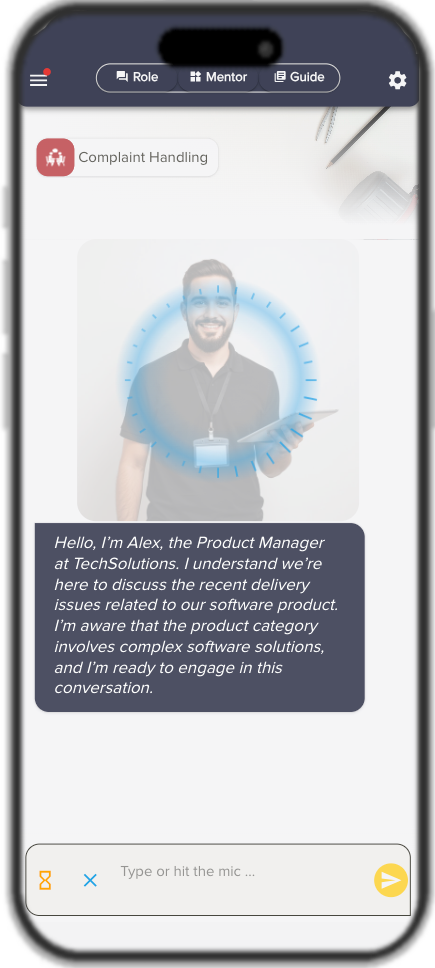
Different roles require entirely different communication tools. We’ve pre-built a massive library of AI role-play cases designed to solve the exact friction points your teams face every day.
For the Sales Team: Closing Deals, Not Just ConversationsSales reps often freeze when a prospect throws an unexpected curveball. By engaging in private, judgment-free practice, reps build the confidence to dismantle buyer resistance naturally.
For Leadership: Managing People, Not Just TasksManagers often avoid tough conversations because they don't want to come across as the "bad guy." AI coaching simulation gives leaders a place to test their phrasing and emotional intelligence.
For Every Employee: Owning Your Career and BoundariesA resilient workforce is an empowered one. We give employees the tools to advocate for themselves and handle workplace dynamics with emotional intelligence.

Templates are great for getting started, but reality is rarely boilerplate.
That’s why we built the "My Scenario" feature. Coachees can select a main template (like "Negotiation") and then type in their exact, real-world context: "I am talking to Sarah, she’s mad about the Q3 delivery delay, and she wants a 15% discount." The AI instantly generates a custom roleplay case based on those exact parameters.
To make it even more grounded in reality, the platform can ingest your company's actual factual knowledge. You can upload your specific sales rubrics, HR policies, or product specs, and the AI will use your internal company content to make the simulation hyper-relevant.
Finally, for enterprises that want to own the experience, we offer a complete White Label AI coach. You get all of this powerful conversational AI training wrapped up in your own company’s branding, colors, and logos, complete with backend analytics to track your team's soft skill improvements over time.
Roleplaying doesn't have to be something your team dreads anymore. It can be the secret weapon that makes them unstoppable.
We don’t believe in "one-size-fits-all" training. Communication is nuanced, which is why we’ve curated a deep library of specialized roleplay categories. Whether you’re a sales vet, a first-time manager, or an ambitious employee, these scenarios are designed to turn theory into second nature.
Leadership isn't a title; it's a series of conversations. Our leadership suite helps managers move from "managing tasks" to "inspiring people" by practicing the high-friction dialogues that usually cause 2:00 AM insomnia.

In sales, the "batting cage" should never be a live client call. Our sales roleplays are designed to help your team hit their quota by mastering the psychological triggers of the buying journey.
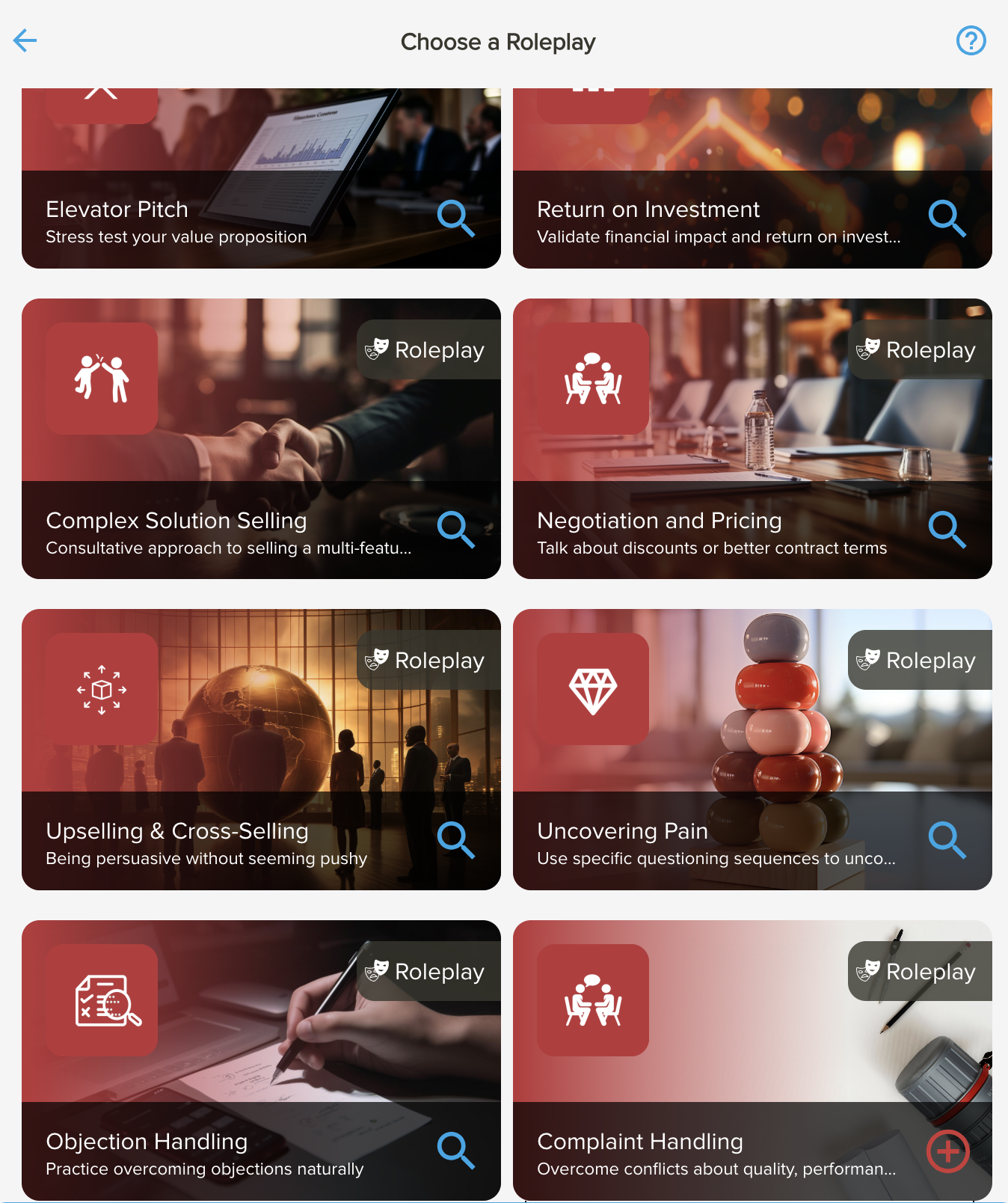
Technical skills get you the job; soft skills get you the promotion. These scenarios help employees navigate the "invisible" office dynamics that define long-term success.
For those ready to level up, our job-seeker simulations act as a final dress rehearsal.
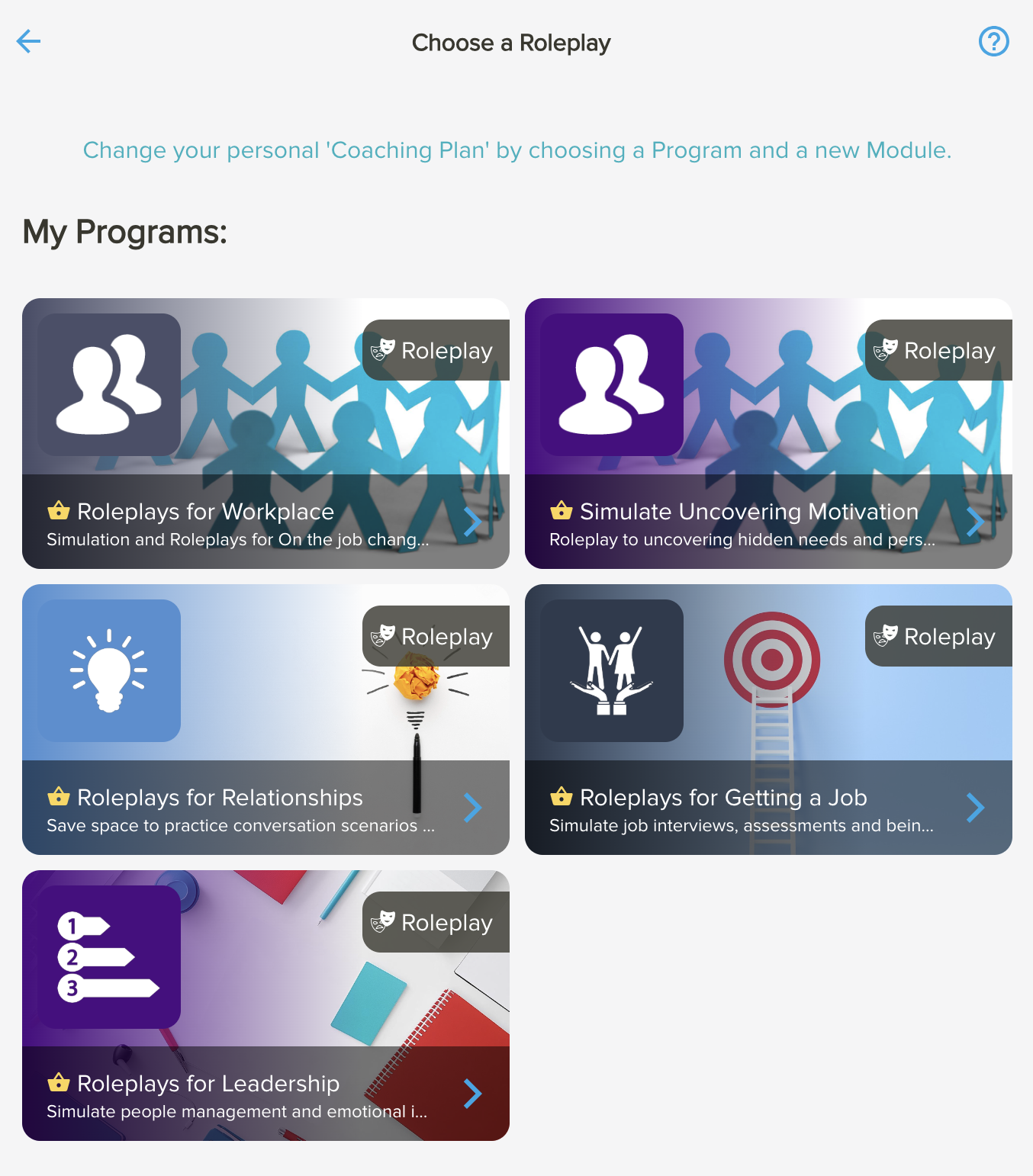
Most AI training tools are just mirrors—they reflect generic information back at you. Rocky.ai is different. We’ve built what we call a "Coaching OS" (Operating System). It’s not just a feature; it’s the foundational engine that allows an organization to take its unique "secret sauce"—its specific sales models, leadership frameworks, and product nuances—and turn them into a living, breathing digital coach.
Here is how we bridge the gap between "generic AI" and "Your Company’s Intelligence."
Every great company has its own way of doing things. Maybe you use a specific "Consultative Selling" model or a unique "Three-Step Feedback" framework. Traditionally, these live in dusty PDFs or forgotten slide decks.
With Rocky.ai, you can hard-code your proprietary methods into the AI’s DNA.
We live in a "swipe and scroll" world, yet corporate training often feels like it's stuck in 1998. Rocky.ai is built as a mobile-first ecosystem.
For consulting firms, training providers, and large-scale HR departments, the "edge" isn't just using AI—it's owning the AI.
Rocky.ai offers a complete White Label solution that allows you to provide a world-class Coaching OS under your own brand.
The market is flooded with "chatbots." But a chatbot can’t remember your career goals, it doesn't know your company’s Q3 product roadmap, and it can’t be rebranded to fit your corporate identity.
Rocky.ai is the only platform that merges Deep Memory, Enterprise Knowledge, and Behavioral Science into a single, white-labeled interface. We don't just teach people how to talk; we coach them on how to win within your specific business ecosystem.
Revolutionizing corporate coaching by offering a scalable, personalized, and white-label AI platform tailored for professional coaches serving corporate clients. Unlike traditional AI tools that merely clone a coach's voice for lead generation, Rocky enables coaches to build and deploy their full coaching methodology—from leadership programs to conflict resolution simulations—on a branded platform.
This is the fundamental difference between simple AI coaches and rocky.ai.
For coaches who serve corporate clients, understanding this difference is the key to future-proofing your practice. One tool helps you get leads; the other helps you build an empire.
Rocky.ai operates on a fundamentally different philosophy. It’s not a product you buy; it’s a platform you build upon. It’s a white-label AI coaching engine designed for deep, ongoing, and scalable coaching delivery.
This is where the game changes for corporate coaches. You aren’t just cloning your personality for marketing; you are building a scalable, branded, AI-powered version of your entire coaching business.
Key Distinction: Others sell a product (an AI clone for your website). rocky COACHING sells a platform (a tool to build and deploy entire AI coaching programs for your clients).
Head-to-Head: Why Corporate Coaches Need a Platform Feature
The age of AI in professional coaching is no longer a distant future; it’s today’s competitive advantage. For coaches who serve the demanding corporate world, AI promises to scale your impact, deepen engagement, and deliver measurable results.
But a critical choice has emerged. The market is splitting between two very different philosophies of AI coaching, best personified by two platforms: simple one size fits all as Valence with Nadia and Rocky with the custom catalogue of AI coaches and AI Agents each fitting to the matter at hand.
One offers to clone your voice to capture leads. The other offers a platform to build and scale your entire coaching methodology for corporate delivery. For the serious corporate coach, understanding this difference is everything.
There are brilliant tools with a clear purpose: create a “digital twin” of your personality. You feed it your content — blog posts, podcasts, interviews — and it creates an AI chatbot that sounds like you.
Coaches embed this AI on their website to act as a 24/7 representative. It can answer visitor questions, explain your coaching style, and, most importantly, capture email addresses.
Its core strength is lead generation. It’s an interactive business card, an intelligent lead magnet. For individual coaches looking to convert website traffic into initial client calls, it’s a powerful marketing tool.
But for a coach managing a 6-month leadership program for 50 managers at a tech company, the limitations quickly become apparent. A marketing chatbot isn’t designed for deep, structured, and confidential developmental journeys.
This is where rocky.ai enters the picture, built on a fundamentally different premise.
Rocky isn’t a product you buy; it’s a platform you build upon. It’s less of a chatbot and more of an operating system for your coaching business. It is designed from the ground up to enable coaches to deliver their proprietary programs at scale within a corporate environment.
This is the critical distinction:
With rocky.ai, you aren’t just cloning your voice; you are building an entire, branded digital coaching experience that delivers your unique intellectual property.
This is where the game truly changes for corporate coaches.
Other digital twins mirrors your personality. It’s trained to answer questions like you would. This is fantastic for building initial rapport and familiarity.
A Rocky.ai digital twin mirrors your entire coaching methodology. It doesn’t just answer questions; it delivers your structured programs. Imagine creating a fully white-labeled app for your client, “YOOOUR OOOOWN Leadership style,” that includes:
You are not giving clients a generic AI; you are giving them your program, supercharged by AI.


.svg)

