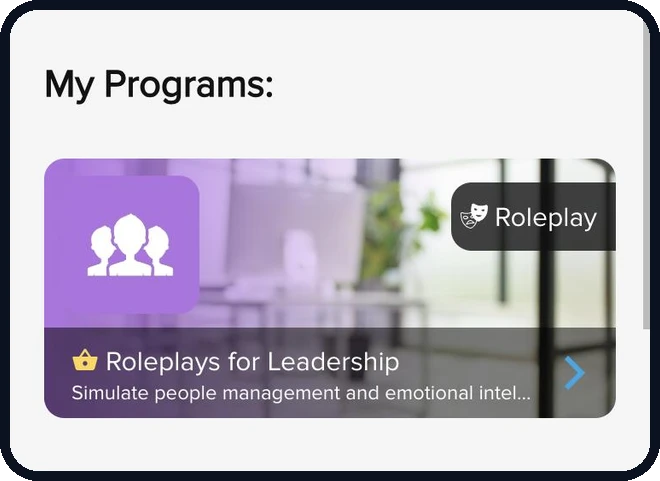
Master Critical Conversations with Generative AI Roleplay


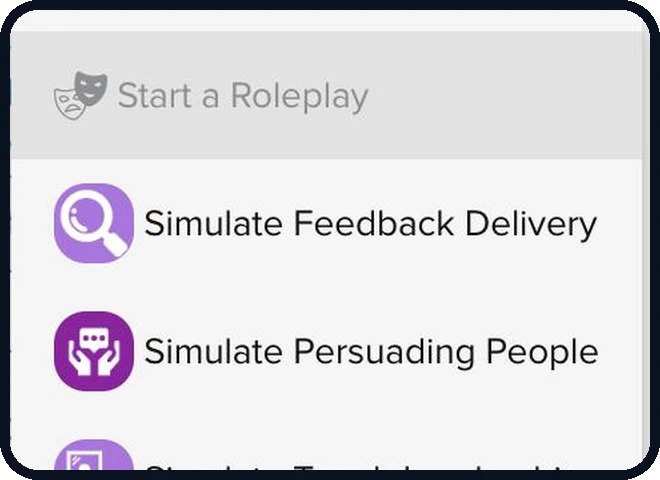
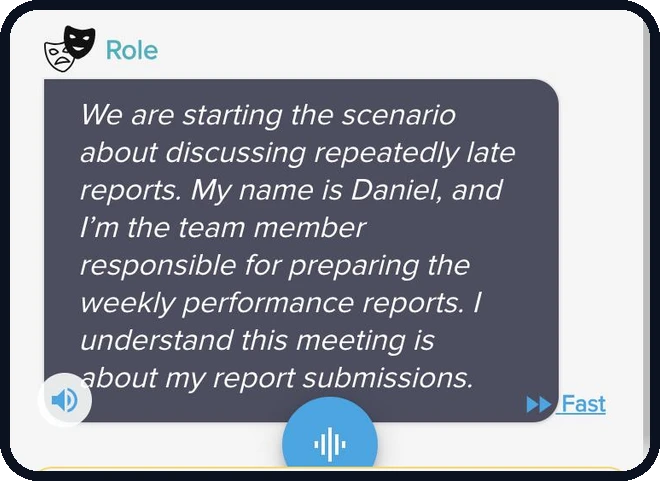
Empower your workforce to practice high-stakes interactions risk-free. From sales negotiation to leadership feedback, Rocky.ai provides dynamic, real-time situational training that pulls in company knowledge and general coaching context for unparalleled realism.

The All-In-One Solution for Effective Leaders, Happy Employees and Healthy Organizations
The cutting-edge AI technology platform built upon the science of positive psychology and solution-focused coaching to empower people to exponential levels of success.

Create your OWN AI-Coach Now for Free

START NOW
or

CONTACT US to get a free demo

Get to know Rocky for Teams and lead your team to performance with the cutting-edge AI technology platform built upon the science of positive psychology and solution-focused coaching!
Thank you! Your submission has been received! ✅
Oops! Something went wrong while submitting the form.
LEAD YOUR TEAM TO PEAK PERFORMANCE WITH AI SOFT SKILLS COACHING
REQUEST DEMO
Activate Rocky for Coaches
AI Roleplay with Avatar Rocky ai Coaching

Customization vs. Templates

Access hundreds of pre-built, expert-vetted scenarios across Sales, Leadership, and HR categories. Get training started in minutes.

Did you know that 83% of change
management and soft-skill
initiatives fail?

Traditional corporate training relies on passive videos or expensive, hard-to-schedule human roleplaying. Employees lack a safe space to fail, practice, and iterate on vital conversational skills.
Here’s why businesses
are switching to our
interactive platform:
Higher Engagement:
Over 60% of employees engage weekly over several months compared to a significant lower percentage with traditional learning management systems.

Daily Use:
About 20% of your team will utilize the Rocky platform as a daily personal coach, wellness assistant, and performance mentor.

Cost-Effective:
Say goodbye to expensive LMS platforms offering low ROI. With Rocky.ai, you invest in a platform that your employees will actually use, making every penny count.

Create your OWN AI-Coach Now

Get a FREE demo first
BOOK a demo
* only for business accounts
or
Don't wait, get started
START building
* from $29 (FREE trial included)

IMPLEMENTATION

Provide your team with relevant, quality, and organization-specific content, increasing skills and knowledge relevant to your business and get your digital twin within 2 weeks.
DEMO
Introduction call with live demo by Rocky.ai Team
DISCOVERY AND TESTING
Access to general public Rocky.ai content for free guided testing
CUSTOMIZATION
Get your learning, training and coaching content integrated as Digital Twin
PROJECT PREPARATION COACHING & SETTING UP
Online workshops for team leaders and setting up
PROJECT ROLL-OUT
Launch your AI coach and digital twin to employees and/or external clients
feature illustration
LEAD YOUR TEAM TO PEAK PERFORMANCE WITH AI SOFT SKILLS COACHING
REQUEST DEMO
Activate Rocky for Coaches
benefits
how it works

Optimal ENGAGEMENT
in 3 Simple Steps🚀

Psychology shows us that humans need three things to stay engaged.
They need to feel autonomous in their choices, competent in what they do,
and connected to others as they make progress towards their goals.

Rocky AI nurtures these conditions in just three simple steps:
  • Icon number one for Optimal Motivation within Rocky.ai
    ACCESS Rocky for TEAMS and the Web APP

    Visit our user-friendly platform, Rocky for Teams.
    Leaders can access a simple dashboard, from which they can monitor the engagement, performance and progress of each team member.

  • Icon for Optimal motivation within Rocky.ai
    Invite MeMbers to START THE App

    Invite your team to download the free app to optimize their potential. Allocate individuals into specific groups for desired learning outcomes. Effortlessly tailor the programs to meet individual needs. Get your own exclusive web-app URL.

  • Icon for Optimal motivation within Rocky.ai
    ENGAGE With Personal Development Training

    Interact with the team in real time, to maximize team accountability towards goals. Control this easily from the comfort of your dashboard, which communicates straight to their app and keeps momentum high.

Exclusive for organizations and Coaches

AI Coaching for Businesses

Create your White Label AI Coach and Digital Twin

Small Teams
Your Brand, Your Content, Your AI
Get an exclusive webapp
Demo your app to users
Creator mode for coaching, roleplays and self-assessments
Your own coaching program
Your own content (videos, articles,...)
Your exclusive domain-code
Coach your team
Coach Panel & Monitoring
5 users included
For coaches and organizations
FREE TRIAL (14 Days)
$99
billed
monthly
Launched immediately

Special: Build your white-label first for $29 per month and upgrade later
Medium Teams
Your Brand, Your Content, Your AI
Get an exclusive webapp
Sell your app to individuals
Creator mode for coaching, roleplays and self-assessments
Your own coaching program
Your own content (videos, articles,...)
Your exclusive domain-code
Add your own store
Coach Panel & Monitoring
20 users included
For coaches and organizations
FREE TRIAL (14 Days)
$199
billed
monthly
Launched immediately
Large Teams
Your Brand, Your Content, Your AI
Get an exclusive webapp
Sell your app to businesses
Creator mode for coaching, roleplays and self-assessments
Your own coaching program
Your own content (videos, articles,...)
Your own domain integration
Custom Feat. (SSO, assessments,...)
Coach Panel & Monitoring
any number of users
Only for selected partners!
BOOK A CALL
$1-10
billed
monthly per user
Price per user depend on volume of licenses and annual commitment
Limited Offer

Create your OWN AI-Coach Now

Get a FREE demo first
BOOK a demo
* only for business accounts
or
Don't wait, get started
START building
* from $29 (FREE trial included)

ACTIVATE your AI COACH Now
and start

or

CONNECT to get a free demo

Get to know Rocky for Teams and lead your team to performance with the cutting-edge AI technology platform built upon the science of positive psychology and solution-focused coaching!
Thank you! Your submission has been received! ✅
Oops! Something went wrong while submitting the form.
With Rocky.ai, take a leap away from ineffective classic LMS and join hundreds of satisfied organizations benefiting from our unique approach to continuous learning and development. Start your journey with Rocky For Teams today.

What people say about
rocky for teams

"Rocky for Teams is the most exciting new development in our coaching practice.
It captures the interest of our clients and contributes to the growth of our business."

Gilles Rochefort

Personal Management Coaching

"Rocky for Teams is my own daily Coach as well as being a great supporter to each of my coaching clients. Rocky enables me to be there for them 24/7."

Bob Hayward

Author, Executive-Coach, Speaker and Consultant

Do you have the time, finance, and skills to deliver personalised coaching to your people?

redeem your free access

Our Team

We are a small team commited to democratising coaching!

HARRY NOVIC

Founder / CEO / CTO

LISA AVERY

Head of Coaching

ELISA MORANO

Marketing & Communications

Lee simms

Head of Business Development
KEEP TEAM ENGAGED REMOTELY
START ROCKY for TEAMS
Activate Rocky for Coaches
LEAD YOUR TEAM TO PEAK PERFORMANCE EASILY
REQUEST DEMOSTART ROCKY for TEAMS
Activate Rocky for Coaches
Frequently Asked Questions
What is AI roleplay training?

AI roleplay training is soft-skills practice in which an employee rehearses a high-stakes conversation against a generative AI counterpart that stays in character, adapts, and then scores their performance — replacing peer roleplay, which most people find too uncomfortable to learn from.

Traditional corporate roleplay fails for a reason everyone recognises and nobody says aloud: it's socially excruciating.

You cannot build conversational muscle memory while performing in front of colleagues who'll still be your colleagues on Monday. Performance anxiety crowds out learning entirely. And the feedback is polite, therefore useless — "good job, maybe more eye contact."

E-learning replaced this with videos and quizzes, which fail differently: they test recall, not behaviour. You cannot learn to handle a hostile customer by watching a video about handling hostile customers, any more than you can learn to bat by reading about batting.

What works is the batting cage: high-volume, private, low-stakes repetition with immediate specific feedback. AI roleplay is the first technology that makes that economically possible for everyone rather than a coached few.

What leadership scenarios are available?

Delivering feedback, setting expectations, delegating, leading change, engaging resistance, de-escalating conflict, coaching others, and tough leadership conversations.

Managers avoid hard conversations because they don't want to be the bad guy. So the conversation gets postponed, the problem compounds, and by the time it happens it's much worse than it needed to be.

Practice removes the dread:

  • Feedback delivery — turning a critique into a growth catalyst without triggering defensiveness
  • Engaging resistance — navigating "we've always done it this way" and converting skeptics into early adopters
  • Leading change — bridging corporate strategy and team-level reality with some empathy intact
  • Team conflict — de-escalating friction and handling HR-sensitive moments with poise
  • Delegating and expectations — defining the what and the how clearly enough that people can run without being micro-managed
  • Coaching others — because your managers should be coaches too

These are the conversations that cause 2am insomnia. Rehearsing them privately is the difference between a manager who handles it and one who avoids it for another quarter.

What career and workplace scenarios can any employee practise?

Selling your value, requesting a promotion, negotiating salary, setting boundaries, saying no, handling criticism, effective apologies, repairing trust, and inclusive dialogue.

Technical skills get someone the job. Soft skills get them the promotion — and they're taught to almost nobody outside the leadership track.

Career progression — Selling Your Value (essential for performance reviews), Requesting a Promotion, Negotiating Salary. Learning to articulate impact factually rather than apologetically.

Sustainable working — Setting Boundaries, Saying No, Expressing Needs. The art of declining well so people can focus on high-impact work without burning out.

Resilience — Handling Criticism, Reacting to Reviews, Effective Apologies, Repairing Trust. Everyone messes up; few are ever taught how to repair it.

Culture — Inclusive Dialogues.

Offering these to everyone rather than just leaders is one of the clearer signals an organisation can send about who development is for.

Are there interview-prep roleplays?

Yes — first interview, difficult interview, explaining CV gaps, discussing weaknesses, verifying skills, and negotiating a job offer.

Worth being direct about the interesting version of this question: why would we help employees interview elsewhere?

Because they're going to anyway, and because the same scenarios serve internal mobility. Someone preparing for an internal move, a promotion panel or a stretch role needs exactly these skills. Organisations that support career development openly tend to retain people longer than those that pretend the outside market doesn't exist.

For universities, bootcamps, outplacement providers and career coaches, this set is a product in its own right — a final dress rehearsal that can be run twenty times rather than once.

Does the roleplay give feedback, or just chat?

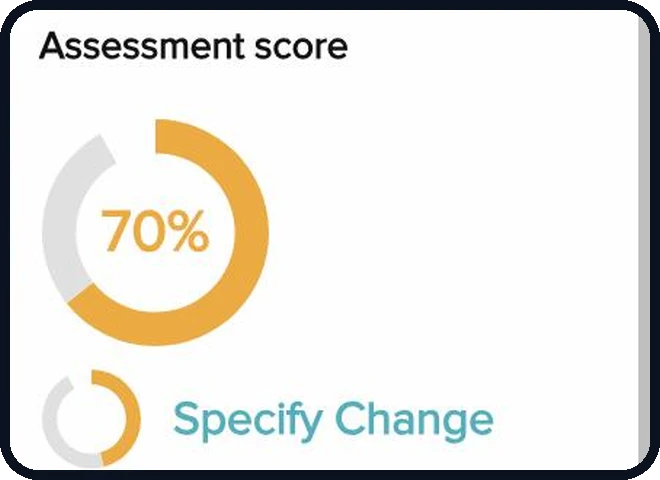
It assesses. The AI evaluates not only what you say but how you say it — pacing, filler words, delivery — and scores against your rubric.

A roleplay without assessment is theatre. You perform, it ends, you learn nothing except that it happened.

The assessment covers both dimensions:

What you said — did you uncover the pain, handle the objection, hold the boundary, structure the feedback? Scored against your rubric, not a generic one.

How you said it — pacing, filler words, delivery, confidence.

The rubric point is the important one. Generic scoring rewards generic behaviour. If your organisation has a specific feedback model or selling methodology, the assessment should measure against that — otherwise you're training people toward someone else's standard while telling them to follow yours.

What should we ask a roleplay vendor before buying?

Whether it ingests your proprietary content with weighted retrieval, what happens to your IP, whether the assessment rubric is yours, whether roleplay connects to goals and coaching history, whether it's mobile-first, and its compliance posture.

Seven questions, in the order that exposes the most:

  1. Can it ingest our content, and how is it retrieved? "We have RAG" is not an answer. Ask whether retrieval is weighted toward your material, or whether the base model's generic advice competes with it.
  2. What happens to our IP? Is our methodology used to train models for others? Does it stay exclusive to our instance?
  3. Whose rubric scores the performance — ours or theirs? Generic scoring rewards generic behaviour.
  4. Is the roleplay connected to anything? A module that doesn't talk to goals, coaching history and L&D tracks is a toy.
  5. Where does it run? If it needs a laptop and a login, adoption dies. Mobile-first outranks every feature on the list.
  6. Can we white-label it? For consultancies and large HR functions, the branding is the product.
  7. Compliance. GDPR, PII filtering, SSO, data controls — before the pilot, not after.

Ask us these too. If any answer disappoints, that's useful information.

How do I measure impact from a Coaching OS?

Through skill progression, practice frequency, chat & roleplay assessment scores and competency growth — not login counts. Activity data measures usage; the platform is designed to surface behaviour change.

Here's the uncomfortable question to put to any vendor: if your success metrics are activity data, what exactly are you measuring?

Completion rates and logins tell you people opened a thing. They don't tell you whether a manager now gives feedback differently, or whether a rep handles the pricing objection without freezing.

What to track instead:

  • Skill progression — is competency measurably improving, per person and per cohort?
  • Practice frequency — how often are people rehearsing the behaviours that matter?
  • Gap concentration — where are capability gaps clustered, so L&D spend can follow evidence rather than instinct?
  • Which scenarios get used — real demand signal, revealing what your workforce is actually anxious about.

That last one is quietly the most valuable report you'll get. It tells you where the organisation hurts.

Can employees run AI roleplays using our own company context and documents?

Yes. Upload your sales rubrics, product specs, HR policies and methodology, and the roleplay runs inside that context — the simulated buyer objects using your real competitive dynamics, and performance is scored against your rubric.

This is the line between a demo and a training system.

In generic roleplay, a rep practises against an invented buyer with invented objections. Useful for confidence, useless for transfer. In context-grounded roleplay, the AI buyer raises your actual pricing objection, compares you to your actual competitor, and pushes back using your real market dynamics — then scores the rep against your sales rubric.

Only the second one changes what happens on Tuesday's call.

There's also a layer above that most vendors don't reach: connecting the roleplay to the person's coaching history. If an employee set a goal of "give harder feedback without damaging the relationship" in Monday's session, Tuesday's roleplay prioritises exactly that, and Friday's summary shows whether it moved. Practice stops being an event and becomes a loop.

And when the template doesn't fit reality — which is most of the time — the learner just describes their actual situation: "I'm meeting Sarah, she's furious about the Q3 delay and wants 15% off." The AI builds the scenario from those parameters.

Can AI roleplay and coaching use our own company context?

Yes. Upload your rubrics, product specs, policies and methodology, and the AI buyer objects using your real competitive dynamics while performance is scored against your criteria.

There are four levels of AI roleplay, and knowing where a vendor stops tells you what you're buying:

1. Scripted

Branching dialogue tree. Same path every time.

2. Generative, generic

Plays a role convincingly but knows nothing about your business.

3. Generative + company context

Behaves like your buyer. Scores against your rubric.

4. Context + coaching memory

All the above, plus aware of the learner's goals and history.

How many roleplay scenarios are included?

Rocky.ai ships a library of 40+ scenario templates across sales, leadership, career and interview skills, plus a scenario feature to generate custom cases from a plain-language description.

The library covers five domains: sales and revenue, leadership and management, career and workplace EQ, interview preparation, and influence and motivation.

But the template count matters less than the custom generation, because reality is rarely boilerplate. Nobody's actual difficult conversation is "Negotiation, generic." It's "Sarah is furious about the Q3 delay, she's a three-year customer, and she wants 15% off before she'll renew."

The "My Scenario" feature takes exactly that description and builds the case from it. In practice that's where most of the value sits — the library gets people started, the custom scenarios keep them coming back.

What sales scenarios can reps practise?

Objection handling, complaint handling, negotiation and pricing, upselling and cross-selling, elevator pitch, articulating ROI, uncovering pain, and solution selling.

Mapped to what each actually fixes:

Increase win rates — Objection Handling and Complaint Handling against a realistic AI buyer. Reps freeze on curveballs; private repetition removes the freeze.

Maximise contract value — Negotiation and Pricing, Upselling and Cross-Selling. Rehearse defending your margin somewhere that isn't a live deal.

Shorten the cycle — Elevator Pitch, Return on Investment, Uncovering Pain. The diagnostic questions that surface a prospect's real business problem instead of their stated one.

Solution Selling — moving past feature recitation.

With company context loaded, the AI buyer raises your real pricing objection and compares you to your real competitor. That's the difference between a rep who's rehearsed and a rep who's rehearsed for this.

What if the AI scenario template doesn't match my real situation?

You can in every scenario add your own information to set the context. In addition you can build custom agents.

This is the feature that gets used most, and it's easy to see why.

Templates are useful for getting started and for structured programmes. But the conversation someone is genuinely anxious about is always specific: this person, this history, this demand, this week.

The workflow is simple — pick a base template like Negotiation, then describe the real context. The AI builds the case around those parameters, including the personality and the stakes.

The practical effect is that practice happens right before it matters, which is exactly when motivation is highest and retention is best. Someone with a difficult meeting at 3pm can rehearse it at 2:40 on their phone.

Is AI roleplay better than human roleplay?

For volume and honesty, yes. Employees will privately rehearse something twenty times that they'd refuse to attempt once in front of colleagues, and the AI's feedback is specific rather than socially cushioned. Human roleplay retains value for the final rehearsal.

Where AI wins clearly:

  • Volume. Twenty reps instead of one. Repetition is the mechanism, so this is decisive.
  • Privacy. No colleagues watching, so people attempt things they'd never risk publicly.
  • Honesty. The AI has no relationship to protect, so the feedback is specific.
  • Availability. 2am, on a phone, the night before.
  • Consistency. Every employee gets the same quality, not whoever they were paired with.

Where humans still matter: group dynamics, observation, the felt weight of a real person's reaction, and the accountability of another human's expectations.

The sensible design uses AI for the reps and humans for the final rehearsal — and that combination outperforms either alone. Anyone claiming AI wholly replaces human practice is overselling.

Is the roleplay connected to the rest of the coaching?

Yes. A roleplay is aware of the learner's goals and coaching history and feeds back into their development plan — so practice is a loop, not an isolated drill.

This is level 4, and it's what most vendors don't reach.

Concretely: an employee sets a goal in Monday's coaching session — give harder feedback without damaging the relationship. Tuesday's roleplay prioritises that dimension in both scenario and scoring. Friday's summary shows whether it moved. Next Monday's coaching picks up from the evidence.

Compare a standalone roleplay module: someone does a simulation, gets a score, and nothing anywhere else in their development is aware it happened. The score means little because nothing connects to it.

Behaviour change is a loop — goal, attempt, feedback, adjust, repeat. A roleplay disconnected from goals and coaching has removed three of the four steps.

How long does a roleplay session take?

Rocky.ai is designed mobile-first for short sessions — five minutes between meetings or on a commute — because that's the only way repetition actually happens.

Session length is an adoption decision disguised as a design detail.

A 45-minute simulation is a calendar entry. Calendar entries get moved, then moved again, then cancelled. A five-minute session is something you do while waiting for a meeting to start.

Since repetition drives the outcome, and short sessions are the only ones that repeat, short wins — decisively. Twenty five-minute reps beat two 45-minute ones, both in practice volume and in the far more important sense that the twenty actually happen.

Research on coaching effectiveness consistently finds shorter, more specific interventions outperform long-form advice, for essentially this reason.

Does roleplay work across mobile and desktop?

Yes. Roleplay sessions sync across mobile and desktop, so an employee can start at their desk and finish on their commute.

Continuity matters more than the feature sounds. Practice interrupted by a device change is practice abandoned — and most working days are a sequence of interruptions.

The pattern in practice: a rep starts a scenario at their desk between calls, gets pulled into a meeting, finishes it on the train. Same session, same context, same feedback thread.

The AI also carries prior coaching conversations across devices, so feedback stays personalised to the growth path rather than resetting with the screen size.

Contact

Contact Us

Picture of illustrated people in the contact section of Rocky for coaches
Thank you! Your submission has been received!
Oops! Something went wrong while submitting the form.